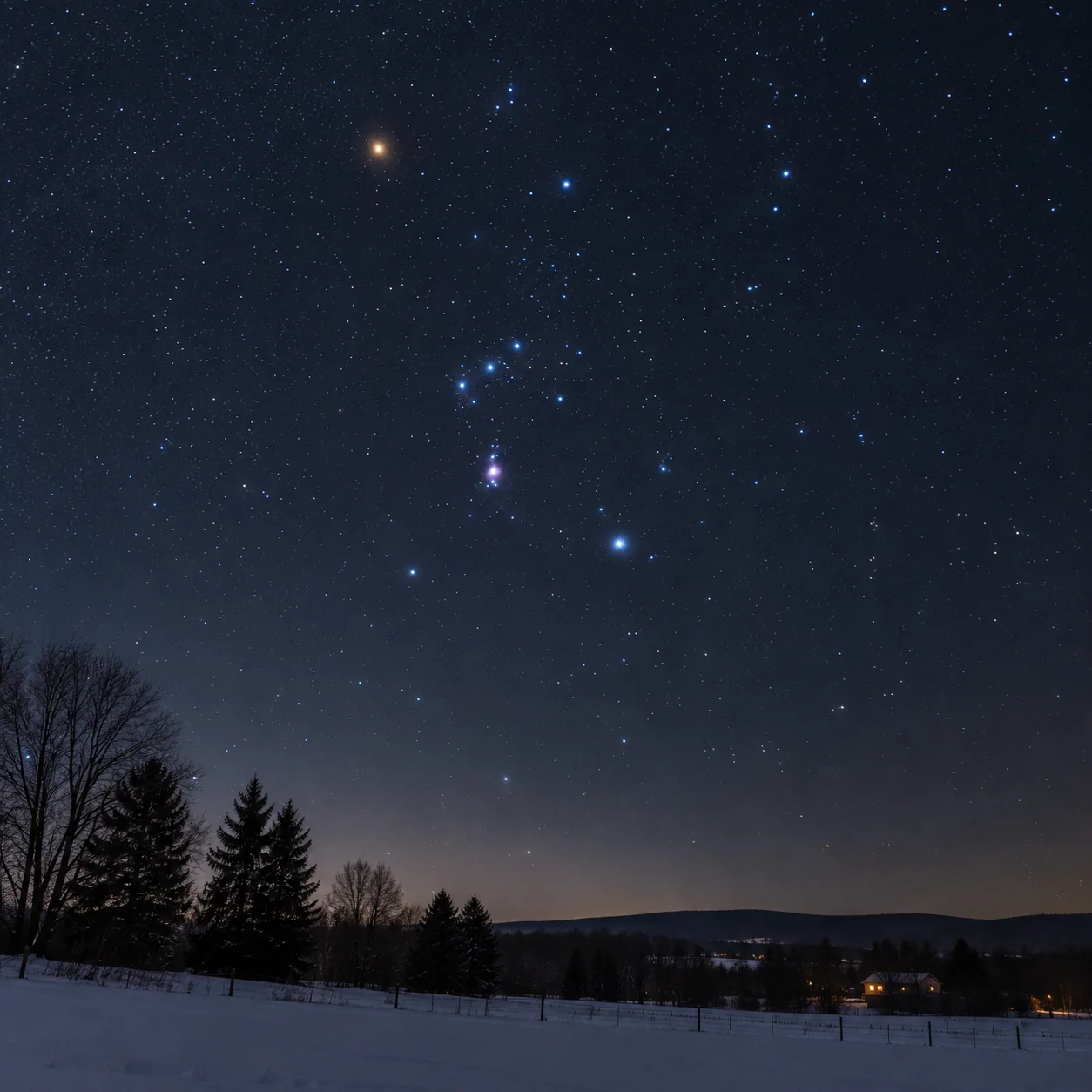
Orion offers a good winter landmark for many northern mid-latitude observers: three conspicuous stars form the Belt, and a shorter row below it marks the Sword. The Orion Nebula sits in that Sword. This is a location-and-season-dependent guide, not a promise that Orion is visible from every country or every month. A current local sky map should confirm that the constellation is above your horizon tonight.
Build the pattern with your eyes
On a clear northern winter evening, look for three stars in a short straight line. Step back mentally and seek brighter stars around them to confirm you have Orion rather than an unrelated trio. The apparent orientation changes as the constellation rises and crosses the sky, and it may look tilted compared with a printed drawing. Use your map's time and facing direction. If buildings block the relevant horizon, move to another safe viewpoint rather than filling in missing stars from memory. Do not use binoculars until you have found the broad naked-eye shape.
Drop from Belt to Sword
The Sword hangs below the Belt in familiar northern-sky diagrams, but “below” refers to the pattern as depicted, not necessarily to the bottom of every horizon view. Identify the shorter group of stars adjacent to the Belt and compare it with your local chart. In that group, the central area can appear softer or hazier under favorable conditions. NASA places M42 in Orion's Sword. A small pair of binoculars may make the region more apparent, although city glare or thin cloud can erase the low-contrast glow.
Expect a soft visual patch
Long-exposure photographs of the Orion Nebula show color and structure that a casual visual observer may not see. Begin by asking whether one patch in the Sword looks less pointlike than nearby stars. Avoid claiming a vivid pink or green cloud just because a generated image displays one. If you use a telescope, start at low power so the field is easy to navigate and the surrounding stars remain context. Record sky darkness, instrument and what you saw. A modest pale glow is a worthwhile observation.
If the field does not match
Check the season, local time and whether Orion has actually risen above your accessible horizon. A planet or bright aircraft can catch the eye, but it will not replace the Belt's three-star pattern. Recheck the map orientation before scanning. If you have binoculars, sweep slowly around the known Belt and Sword rather than hopping to unrelated stars. Let your arms rest if the view shakes. If moonlight or haze is strong, stop and try a darker evening. Not seeing the nebula does not mean you failed to identify Orion.
One follow-up that teaches more
On the next clear night, return to the same location and redraw the Belt and Sword without looking at your first sketch. Compare the spacing of bright points and the appearance of the fuzzy region. If you want to move to another target, the nearby Pleiades are another wide-field beginner reward in a suitable season. Keep the observational questions distinct: Orion teaches you to use a familiar pattern to find a subtle patch, while the Pleiades teach you to count and frame a compact star group.
A Belt-to-Sword route rehearsal
On paper, draw three Belt dots and a shorter nearby Sword line from memory. Outside, locate the Belt with your eyes and orient the sketch to its actual tilt. Now look for the Sword without binoculars. When the two shapes match, raise the binoculars and center the Sword rather than the Belt. If you find yourself sweeping far away, lower them and restart; wide, unstructured scanning easily loses the relation between anchor and target. In a notebook, draw the brighter Sword points and shade any region that seems diffuse. Confirm later with a verified chart, not with the decorative image attached to the article. This process teaches a transferable pattern: secure the large asterism, verify a smaller neighboring shape, and only then inspect a subtle object. Under bright urban skies, the final glow may remain uncertain even when the route is correct. That is an honest result, not a reason to redesign the map in hindsight.
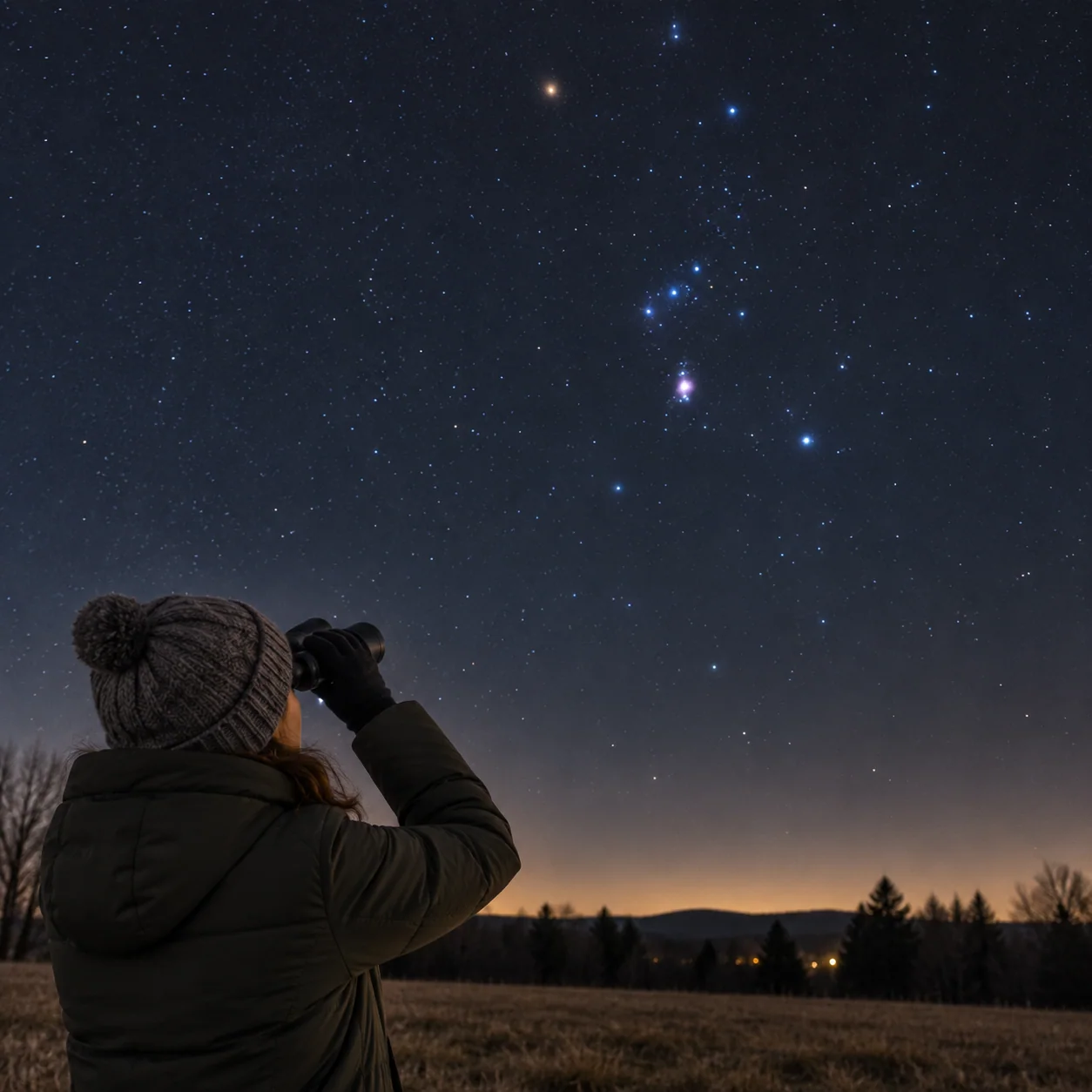
The reward is not a photograph-like nebula. It is the ability to go from a reliable three-star marker to a real, subdued deep-sky object. If you return later in the winter, note how the Belt’s angle relative to your horizon has changed at a similar clock time. The nebula remains in the Sword, but the whole figure’s placement shifts. This is why a step such as “look straight down” is less useful than naming the relationship among stars and checking a current local chart.
Continue observing
- Find the Pleiades: A Small Cluster With a Wide-Field Reward
- 7x35 or 10x50 for Stargazing? Start With What You Can Hold