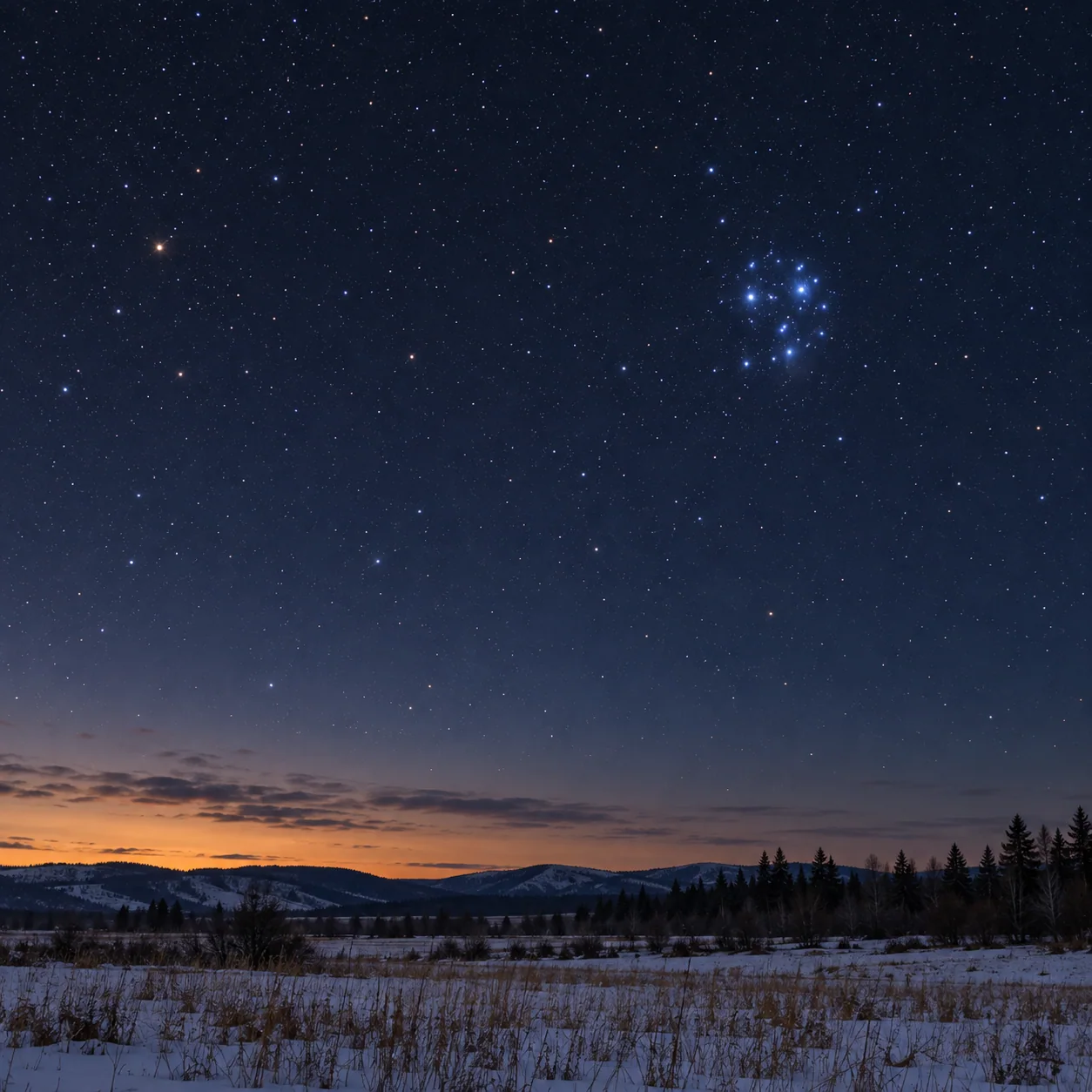
The Pleiades are a compact open star cluster that rewards both naked-eye recognition and a wide binocular field. They are a gentler first target than many galaxies because several bright members can stand out even when the rest are faint. For northern observers they are associated with autumn and winter evenings, but visibility still depends on latitude, date, hour and local horizon.
Find the little cluster
Consult a current chart for your town and date, then look toward Taurus when it is well above the horizon. Seek a tight group of small bright points, sometimes described as a tiny dipper. Do not require a particular star count; eyesight, dark adaptation and sky brightness change what people resolve. A dark, clear field may reveal more than a lit suburban yard. If you mistake a wider cluster for the Pleiades, compare the group's relative position with Taurus on your chart. Recheck the time rather than forcing the identification.
Use the whole binocular field
NASA recommends binoculars as an effective first astronomy instrument and identifies the Pleiades as a large open cluster well suited to them. Raise the binoculars only after you know where the group is with your eyes. Use a comfortable, supported position and focus on a bright member. The cluster should occupy a broad, pleasing region rather than one huge enlarged star. Higher magnification is not necessarily better: a narrow field can make it harder to see the cluster as a family of points.
Count cautiously
Make a quick sketch of only the stars you can distinguish confidently. Repeat after your eyes have had more time away from bright light. If your count grows, note whether the sky also cleared or you steadied the binoculars. Do not compare your visual tally with a photograph's hundreds of faint points as though the two methods have equal sensitivity. A visual observer often sees a handful or more depending on conditions; the useful detail is the pattern and your own instrument's performance at that site.
Trouble locating it
A planisphere can show the group above the horizon while a roof or tree hides it at your observing site. If it is low, wait until a later hour when practical; if the season is wrong, plan for another month. Bright moonlight can reduce surrounding stars and make the group seem less dramatic. Also check whether your binoculars are focused: soft stellar blobs throughout the field may be optical blur rather than a nebula. Return to a clearly bright star, refocus and then revisit the cluster.
A productive second visit
Bring someone new and ask them to describe the shape before naming it. The exercise reveals how different observers connect the same few points into a figure. Then compare their description with your sketch, not with an idealized graphic. If you want a second wide-field target, the nearby Hyades offer a different, more spread-out geometry in Taurus. Treat it as a separate observation rather than implying the two clusters occupy the same tight field in every binocular model.
Two clusters, two visual questions
If the Pleiades are well placed, look at them first with the unaided eye, then with binoculars. Count a few of the clearest points and sketch the compact arrangement. On a separate part of the page, use a current chart to locate the Hyades near Aldebaran in Taurus and compare its more spread-out pattern. Do not insist that both groups fit the same binocular field; the Hyades span a much wider area. The exercise helps distinguish “cluster” as a physical category from “looks like a tiny knot” as a visual description. If city skyglow or a bright Moon reduces faint members, record the effect rather than looking up the expected count and copying it. A later dark-sky visit may reveal more stars around both patterns. The goal is to develop an eye for angular scale, not to memorize how many points a particular photograph contains.
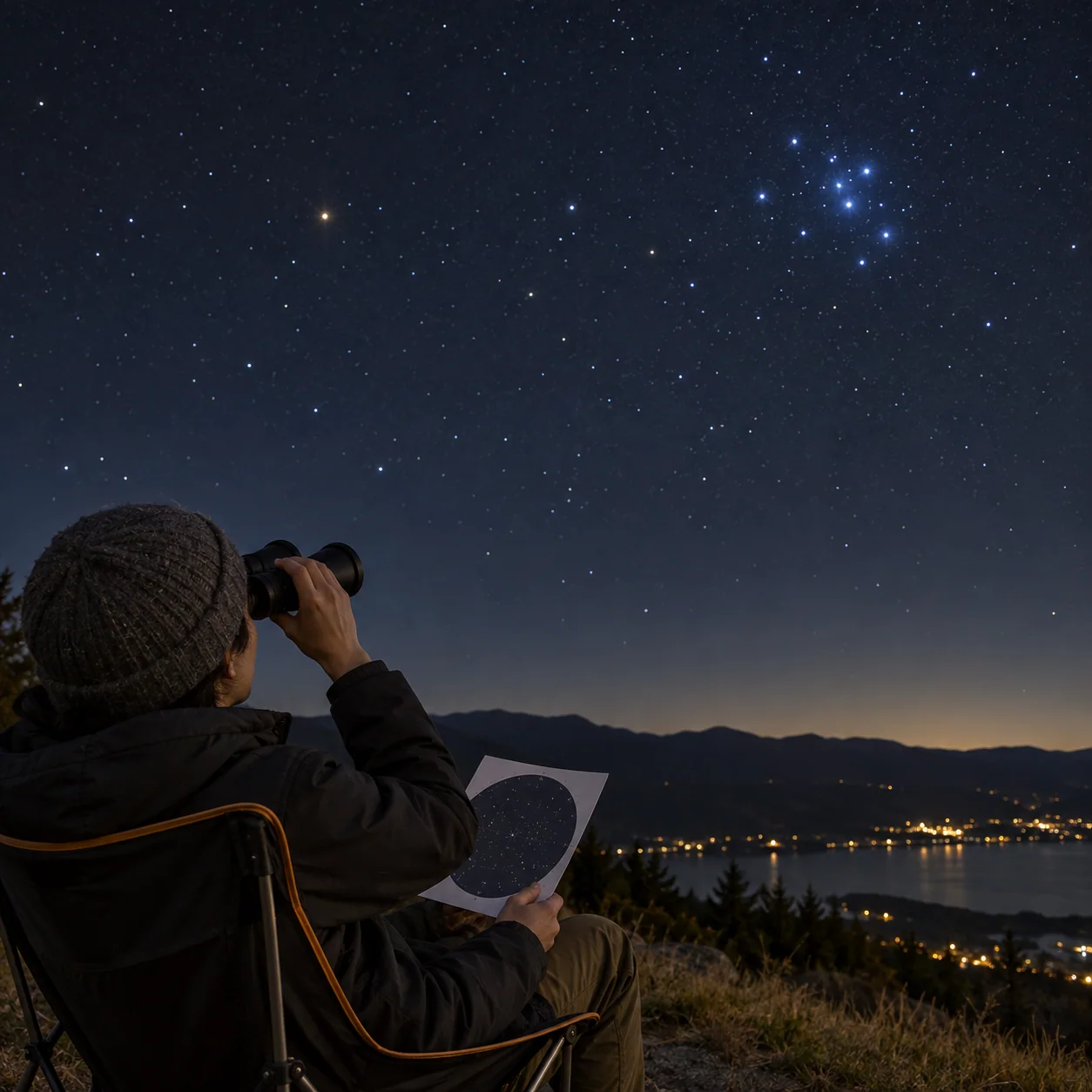
The Pleiades are a lesson in scale: a small-looking naked-eye knot becomes a broad group when framed gently through binoculars. Pleiades photographs often reveal delicate blue haze around stars. Do not promise that color in a casual visual session. A beginner’s more reliable reward is a compact group resolving into separate lights. When you write about the cluster, distinguish this eyepiece experience from photographic structure captured with long exposure and processing. A compact open cluster is not a single fuzzy object; pause long enough to resolve individual points before drawing the outline you think you see.
Continue observing
- Use Orion’s Belt to Find the Sword and Its Fuzzy Nebula
- Focus Astronomy Binoculars One Eye at a Time