A bright Moon changes an observing plan, but it does not automatically cancel the night. Moonlight raises the visible sky background and can make faint, low-contrast targets harder to notice. At the same time, the Moon itself becomes an easy subject, bright stars remain available, and a familiar pattern can still support a useful practice session. The practical response is to spend the night’s limited time on tasks that match the light you actually have.
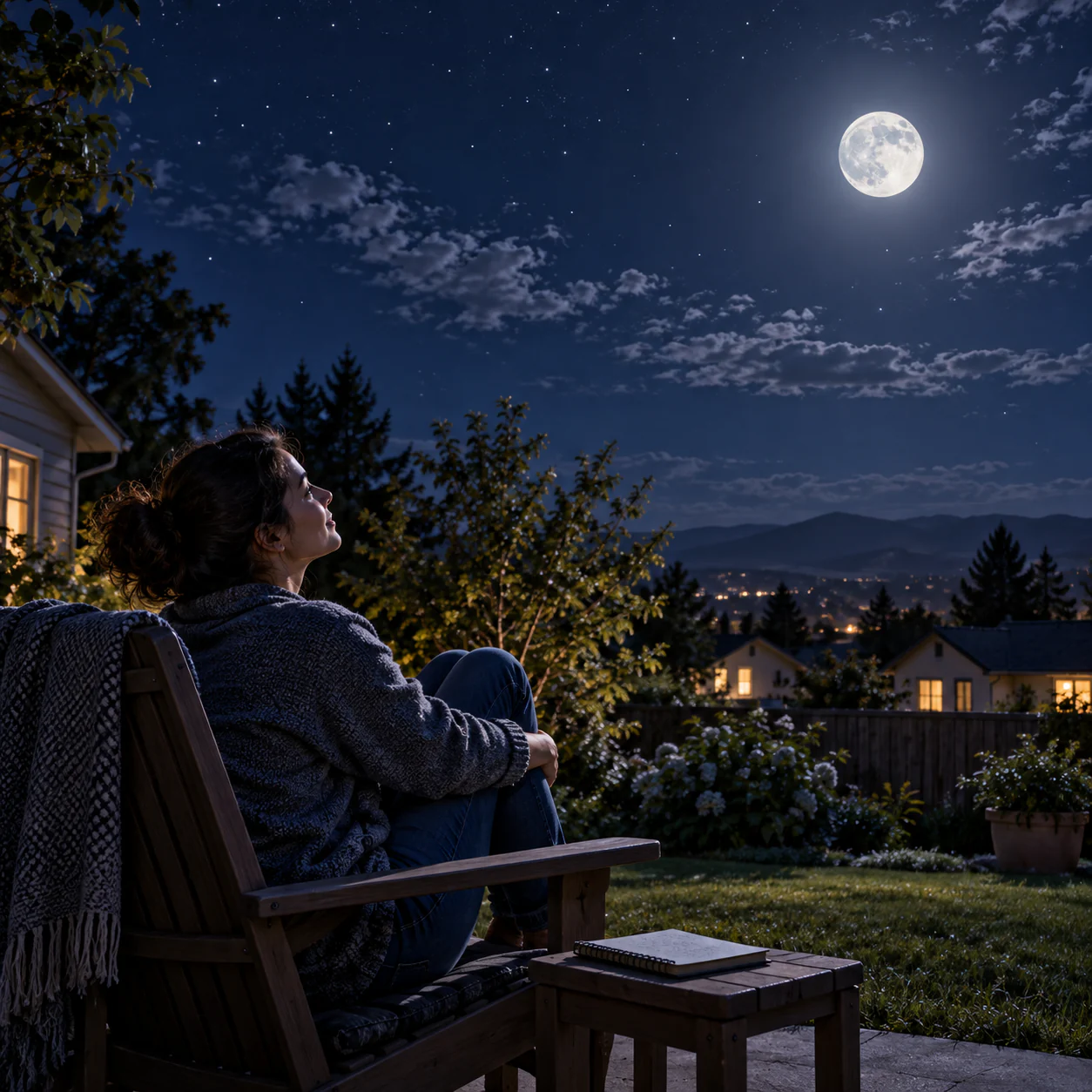
Give the Moon a place in the plan
Check the Moon’s phase, rise time, set time, and direction for your location and date before choosing a target. NASA’s phase guide explains that the geometry of the Sun, Earth, and Moon changes the illuminated portion we see. It also gives familiar timing relationships: a full Moon rises around sunset, while other phases rise and set at different parts of the day or night. Those relationships are useful orientation, but your current local timetable is the one to use outside.
Do not read a phase name as a complete sky forecast. Thin cloud, haze, street lighting, twilight, and the Moon’s altitude can all alter the background. A bright Moon low behind a building may interfere less with one part of the sky than a Moon high beside your intended target. Stand at the actual observing spot and compare the target direction with the Moon’s direction. If a wall, tree, or roof safely blocks direct glare without blocking the target, use it as a shield; never step into a road or unsafe area to improve the angle.
Decide whether the Moon is the subject, a constraint, or a timing marker. Naming its role prevents an evening from becoming an unplanned search for objects that current conditions do not favor.
Spend an observing budget on contrast
Think of contrast as a limited budget. Faint diffuse objects usually need a darker background because their light is spread over an area. Bright points, bold star patterns, and the Moon’s large light-and-dark regions demand less of that budget. This is a planning principle, not a claim that every bright target will be visible from every place.
Build tonight’s list in three levels:
- Reliable work: inspect the Moon with unaided eyes or binoculars, follow a bright constellation pattern with a current chart, or practice focusing and holding binoculars steadily.
- Conditional work: compare a bright cluster or double star with and without direct moonlight in your eyes, provided the target is well placed and known to be suitable for your equipment.
- Defer first: a new search for a very faint galaxy, a low-contrast nebula, or any target that was already marginal from the same site on a darker night.
The third group is not forbidden. It is simply a poor place to spend the first twenty minutes when moonlight is obvious. If you already know a faint target and want a controlled comparison, attempt it after the reliable task and record a non-detection honestly.
Use a Moon-first decision tree
If the Moon shows a partial phase, begin near the boundary between lunar day and night, called the terminator. NASA’s viewing tips note that shadows near this boundary can make surface relief easier to see. Choose one region, sketch the boundary, and stop before the brightness becomes uncomfortable. Ordinary binoculars are never safe for solar observing; make sure the Sun is fully below your local horizon before sweeping near its direction.
If the Moon is near full, expect fewer long shadows across the face. Switch the task from relief to albedo: compare darker plains with brighter highlands, or trace a conspicuous bright ray system. Do not infer height solely from brightness. A pale patch and a raised mountain are different kinds of information, and a full-Moon view can make that distinction especially important.
If direct glare is the main problem, move the Moon outside the binocular field before looking for the other target. Shade your eyes with a hand or fixed structure without touching the optics. Keep nearby household lights out of sight as well. If you cannot do that safely, make the session lunar-only or observe at a different time.
If the Moon has not risen or has already set, use that darker interval for the faintest item on your list. Confirm the exact local times rather than assuming a phase label gives you the whole evening. Even a short interval can be useful when the equipment is ready and the target has already been located on a chart.
Run two observations instead of one vague session
Make the first observation while the Moon is plainly affecting the site. Record its approximate direction and height using simple language such as “high in the southeast,” along with cloud, nearby lighting, and whether the target is visible. Complete one bounded task: identify a pattern, focus the binoculars, or sketch a lunar region.
Then change one condition. You might wait until the Moon moves behind a roof, return after moonset, or repeat the same target on a darker date. Keep the observing place, instrument, and target as similar as practical. The comparison will not be a laboratory measurement, but it can reveal whether direct glare, background brightness, or simple unfamiliarity caused the first difficulty.
Use an outcome scale that allows uncertainty:
- target and surrounding pattern were clear;
- target was visible only after the pattern was confirmed;
- position was found but the target was uncertain;
- target was not seen under the recorded conditions.
A four is useful evidence. It tells you what not to promise another observer and gives the next attempt a starting point.
Try a forty-minute bright-Moon plan
Spend the first five minutes checking the Moon’s position, cloud movement, and the safest viewing direction. Use the next ten minutes on the Moon: unaided shape, dark plains and bright highlands, or a single binocular region. Pause to rest your eyes.
Use fifteen minutes for one bright non-lunar task. Follow a known star pattern, compare two bright stars, or test whether a broad cluster remains recognizable. Work from a current chart configured for your place and time; do not rely on a remembered orientation from another season.
Reserve five minutes for an experiment. Put the Moon behind a fixed obstruction and repeat the view, or compare a target nearer and farther from the Moon. Finish with five minutes of notes. This order guarantees that the evening produces a result before you test a more difficult idea.
The plan can shrink to ten minutes or expand, but it should not turn into a contest with the sky. Stop if glare causes discomfort, if dew reaches the optics, or if the observing spot becomes unsafe. Never point binoculars toward the Sun, including at dawn or dusk.
Let the bright night improve a darker one
Write what the Moon changed rather than describing the night as simply “bad.” Did a roof block direct glare? Could you still trace the selected star pattern? Did the binocular field look washed out only near the Moon, or across the whole sky? Which task remained satisfying?
On the next darker night, repeat one target before adding new ones. If the view improves, you have a useful comparison. If it does not, moonlight may not have been the main limitation; focus, haze, local lighting, target altitude, or an incorrect position may deserve attention.
A bright-Moon session succeeds when the task fits the available contrast. Check local timing, begin with a reliable lunar or bright-star observation, reserve faint objects for a better window, and record uncertainty. That approach replaces an automatic cancellation with a smaller, truthful observing night.
Continue observing
- Reading the Full Moon: Dark Plains, Bright Highlands, and Realistic Detail
- Keep Your Night Vision While Stargazing at Home