Binoculars are an approachable way to begin lunar observing because they are easy to carry and show the whole Moon at once. They will not transform it into a spacecraft photograph. Their strength is making large contrasts easier to inspect while you learn where to look. This is a night-sky guide, not a procedure for observing a daytime Moon near the Sun.
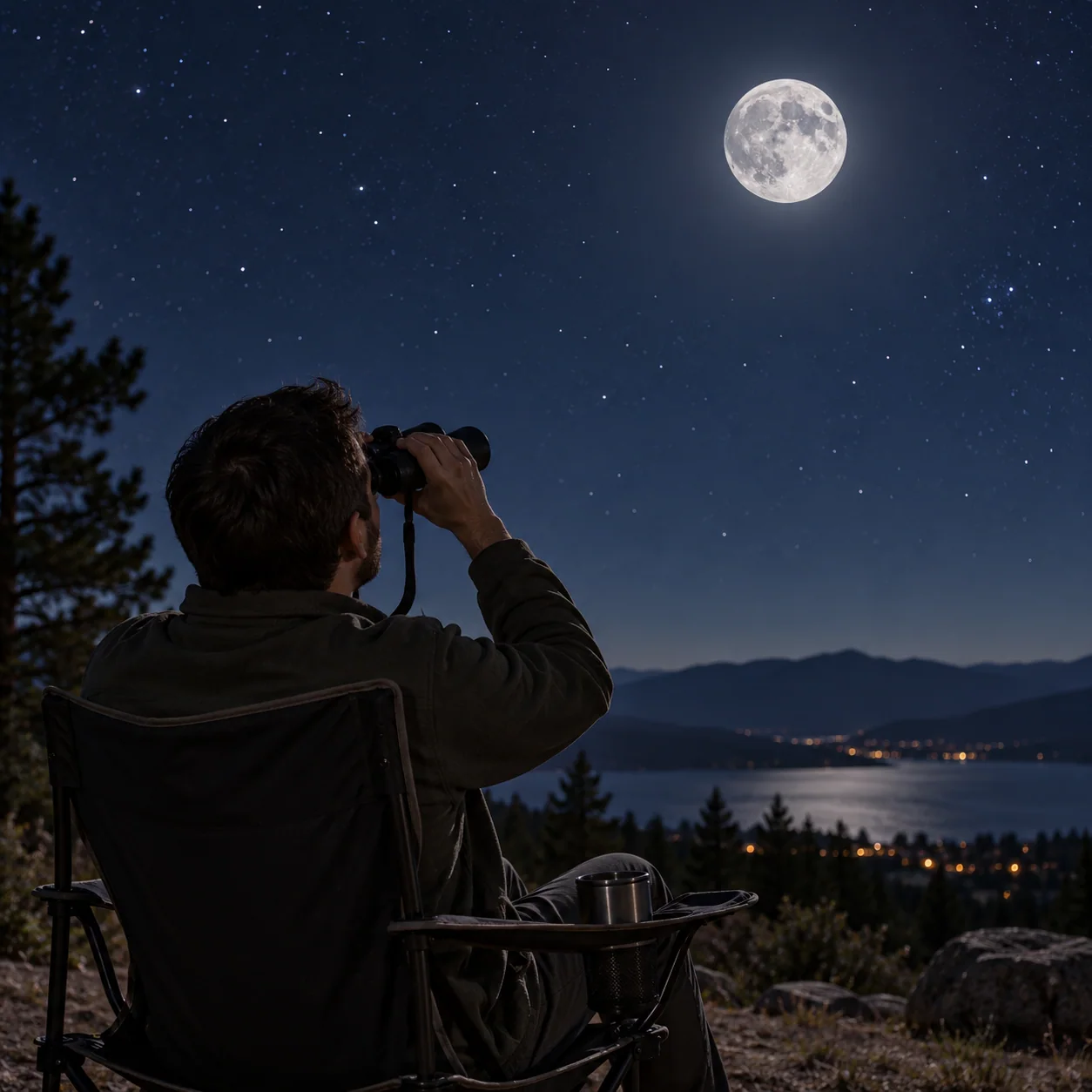
Start with a comfortable view
Use binoculars you can hold without straining. Sit in a chair, support your elbows, and locate the Moon with your unaided eyes before lifting the instrument. Adjust the barrel spacing until you see one round field rather than two circles. Focus on the Moon's edge or a prominent dark region. If the view jiggles, take a break and try again with supported arms. A steadier view often reveals more than an extra increment of magnification. Do not walk while looking through binoculars; lower them before moving.
Look for regions, not tiny craters
The Moon's broad dark plains, called maria, contrast with lighter terrain. At a partial phase, scan along the illuminated boundary for major light-dark relief. Individual small craters may be hard to separate in handheld binoculars, especially under shaky or hazy conditions. Record the features you actually distinguish, not those shown in a detailed orbiter image. NASA notes that binoculars can make lunar observing rewarding, but the usable level of detail still depends on aperture, steadiness and the atmosphere.
A simple comparison between phases
Try a partial Moon and then a fuller Moon. With the same binoculars, the first session can emphasize shadows near the terminator while the second emphasizes large dark-and-light surface patterns. Draw two small circles and mark only the strongest features. State the time and the Moon's approximate height, since a low view through thicker atmosphere can appear softer. If cloud cover differs, do not claim the phase alone caused the difference. That small discipline turns a pleasant view into a useful personal observation.
Brightness and comfort
The Moon can look startlingly bright in a dark-adapted eye, particularly near full phase. If it is uncomfortable, lower the binoculars, take a pause or observe at lower magnification; you do not have to force a long look. Keep the observer's posture relaxed rather than craning the neck under a high target. A reclining chair may help, but check its stability and surroundings. The Moon's brightness is not a reason to improvise a filter with unknown materials. A beginner can simply observe for shorter intervals.
The solar boundary matters even here
The Moon can be visible during daylight, but inexperienced binocular users should not search a bright sky near the Sun. NASA warns that concentrated sunlight through binoculars or telescopes can cause serious eye injury; ordinary eclipse glasses behind the optics are not protective. For this tutorial, choose a night when the Sun is safely below the horizon. Keep lenses capped during transport, and supervise children handling optics. Put the instrument down whenever you need to cross a step or discuss what you saw with another observer.
The one-object binocular drill
Put a chair where the Moon is unobstructed, with no step directly behind it. Locate the Moon without optics and notice where your arms naturally rest. Adjust binocular spacing and focus on the Moon's edge while seated. Take three short looks, lowering the binoculars each time. After each look, write only one change you noticed: perhaps a dark patch, the position of the terminator or the outline of a bright region. Repeated short looks reduce fatigue and encourage you to relocate the target instead of depending on a continuous stare. If you share the binoculars, each observer should refocus rather than assume another person's setting fits their eyes. Do not hand them to a child while a strap or lens cap could snag. At the end, compare the written observations with a current Moon map and circle what you can verify. Leave uncertain features marked as uncertain. This makes the exercise both safer and more honest.
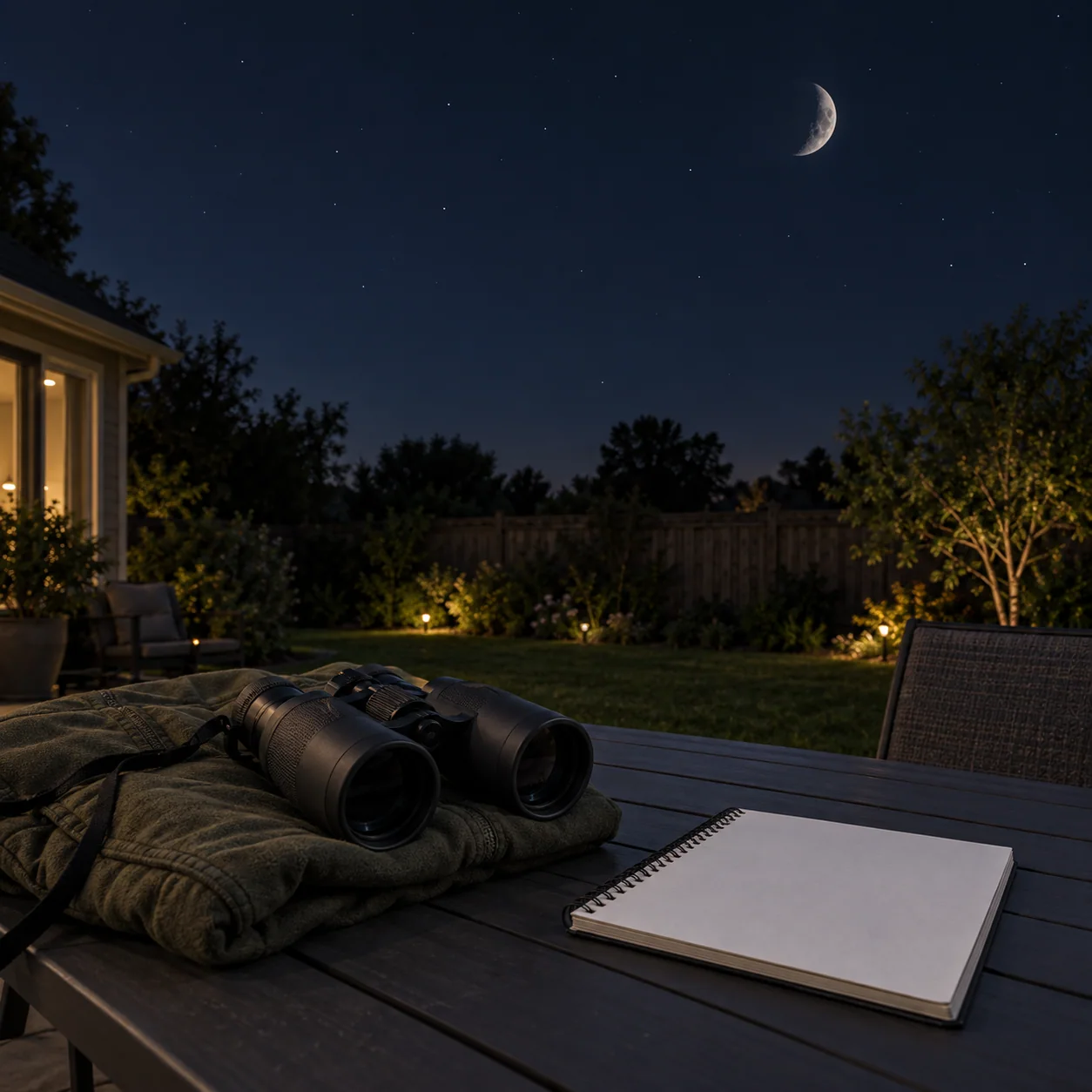
A satisfying binocular Moon session has one or two genuine observations and a comfortable grip. It does not require a detailed crater inventory. If the binocular view feels unexpectedly narrow, compare it with your naked-eye view before looking for small features. The entire Moon should remain a manageable target in ordinary binoculars, and its position in the field can drift as your hands move. Re-center gently; a moving image is not evidence that the lunar surface itself is changing. If the lunar disk fills only a small part of the binocular field, that is normal. Concentrate on a reliable contrast rather than demanding a close-up view.
Continue observing
- Why a Half Moon Can Show More Relief Than a Full Moon
- Big Dipper to Polaris: A Northern-Sky Direction Check