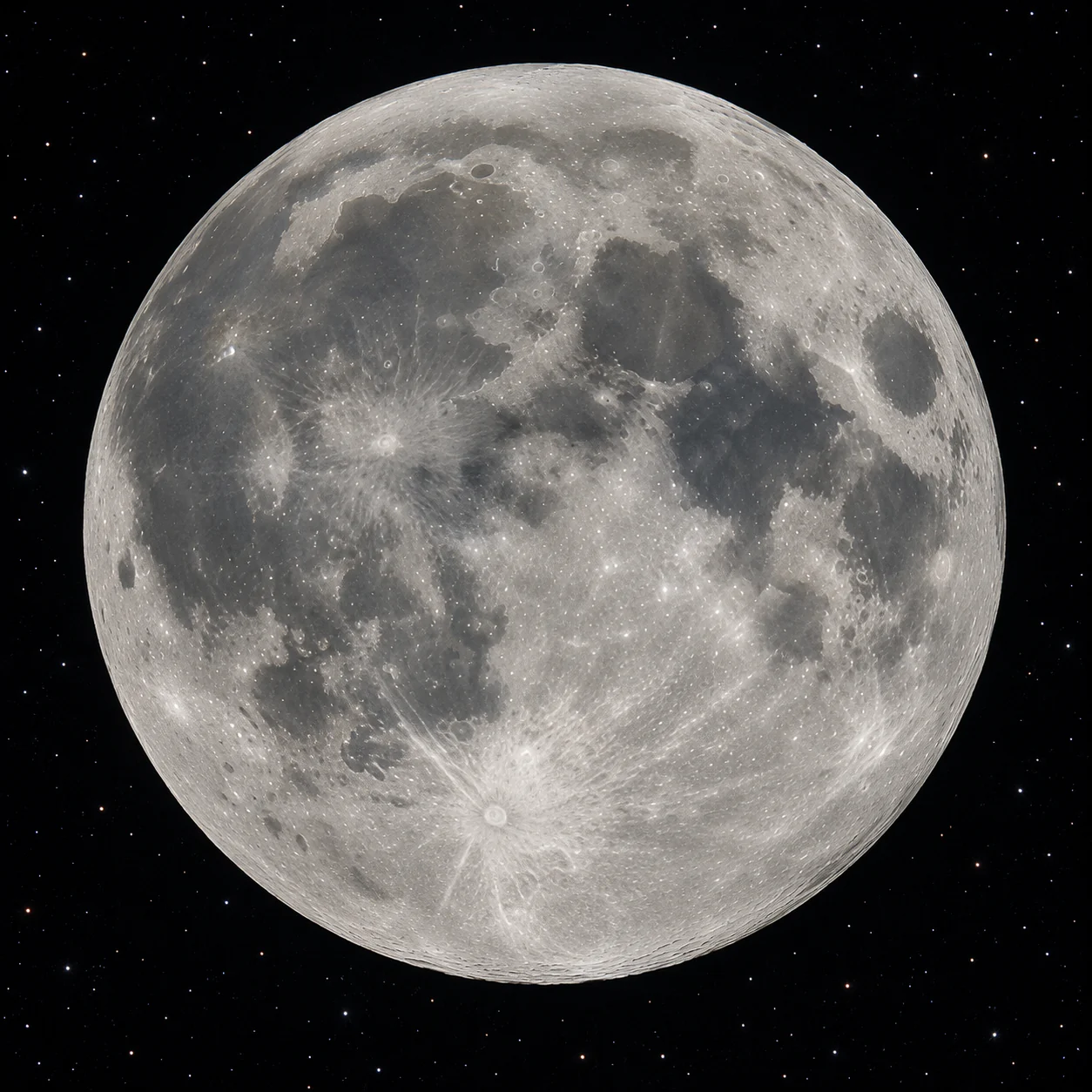
Near full Moon, a bright system of streaks appears to radiate across much of the lunar face from a crater in the southern part of the disk. That crater is Tycho. Its rays provide a useful contrast exercise at a phase when long surface shadows are less prominent. A second visit at a partial phase lets you separate the bright ray pattern from the relief revealed by angled sunlight.
Prepare two visits with different questions
Plan one look within a few nights of full Moon and another when the Moon is partly illuminated. Use a current phase calendar and local rise and set times. The first visit asks, “Where do the brightest long rays appear to converge?” The second asks, “What surface shape and shadow can I see in the same region?” Keeping the questions separate prevents brightness from being mistaken for height.
You can begin with unaided eyes, but binoculars make the comparison easier. A small telescope can show more detail, although it is not required. Whatever you use, never point it near the Sun. Observe only when the Sun is fully below your local horizon, especially if the Moon is a thin phase located in the twilight sky.
Sketch a blank circle before going outside. Mark lunar north only if a reliable chart and your instrument orientation make that meaningful. Binoculars usually show an upright view, while telescopes and diagonals may rotate or mirror the image. Instead of guessing, identify the same two large dark plains in both the chart and the live view and use them as orientation anchors.
Locate the southern bright hub
Near full phase, look first at the whole disk rather than hunting for a small crater rim. Find the broad darker maria and the brighter highland areas. Then inspect the lower half of the Moon as it appears in your view. Tycho is the compact bright hub from which a conspicuous set of pale streaks extends in several directions.
The word “lower” is only a screen or eyepiece description. The image may be rotated, and the Moon’s appearance in the sky changes with location and time. Confirm the feature by the convergence of the ray system and by comparison with a reputable lunar chart. Do not identify every bright patch as a ray from Tycho; other relatively young craters, including Copernicus, also have ray systems.
NASA explains that lunar impact craters are depressions formed when objects struck the surface. With little wind, rain, or plate tectonic activity to erase them, many structures remain visible for immense spans of time. Material thrown outward during an impact can produce ejecta patterns. The bright radial markings around Tycho are a visible ray system, not cracks that split the Moon.
Trace rays without inventing precision
Center the whole Moon in a steady view. Starting at the bright hub, follow one pale streak until it fades into surrounding terrain. Return to the hub before choosing the next direction. This hub-and-return method reduces the chance of jumping from one unrelated bright patch to another.
On the prepared circle, draw only the strongest directions you can actually follow. Use broad, light strokes rather than sharp ruler lines. Rays cross varied terrain and may look interrupted, uneven, or braided. Atmospheric shimmer, hand movement, and the eye’s response to brightness can create a false sense of fine structure. A modest sketch with three confident paths is better evidence than an elaborate map copied from memory.
Add a confidence mark beside each path: clear, intermittent, or uncertain. If a ray seems to reach another crater, state that it appears to do so in your view; do not turn an apparent alignment into a claim about its origin. The NASA image commentary on Tycho and Copernicus provides context for the large ray systems, while your note records only what you saw.
Return when the terminator is nearby
At a partial phase, the day-night boundary crosses the Moon and sunlight strikes some terrain at a shallower angle. NASA’s viewing guidance notes that shadows near this terminator can emphasize surface relief. Time the second visit so Tycho’s region is closer to the terminator, using a current lunar map or observing tool rather than an assumed number of days.
Find the same broad maria first, then return to the southern region. The bright rays may be less dominant than they were near full phase. Look for the crater rim, shadow, central area, and surrounding uneven ground that the available resolution supports. Do not expect a small handheld view to match spacecraft imagery. Seeing a tiny bright or dark mark at the correct location can be an appropriate result.
Make a second circle sketch at the same scale. This time draw the boundary of light and dark and the strongest relief cues. Keep ray brightness and topographic shadow in different pencil styles or notebook columns. The distinction matters: an albedo feature stays bright because it reflects light differently, while a shadow depends on illumination angle.
Compare evidence, not artistic quality
Place the two sketches side by side. On the full-phase page, ask whether the rays guided you to the correct hub and which directions remained traceable. On the partial-phase page, ask whether a rim or shadow made the crater easier to recognize even though the rays were less forceful.
Record the instrument, support method, date, local time, approximate phase, cloud, and atmospheric steadiness for both visits. If the binoculars were handheld one night and mounted the next, note the difference rather than assigning every change to phase. If one observation passed through thin cloud, brightness comparisons are especially uncertain.
Use four outcome statements:
- Confirmed ray hub and crater region: chart, rays, and surrounding pattern agreed.
- Probable region: ray convergence was visible but the crater itself was not resolved.
- Feature seen, identity uncertain: a bright hub was present but orientation did not match confidently.
- Not seen: glare, cloud, motion, or position prevented a reliable identification.
These labels protect the exercise from a familiar-name bias. Knowing Tycho should be there does not guarantee that every bright point is Tycho.
Extend the comparison carefully
After confirming Tycho, look for a second ray system rather than immediately naming many craters. Copernicus, located elsewhere on the lunar face, is a useful comparison in NASA’s full-Moon imagery. Note whether its rays seem shorter, less dominant, or simply harder for your instrument. Treat those as observations under one set of conditions, not fixed measurements.
You can also repeat Tycho at a third phase or with a steadier support. Change one variable at a time. A phone photograph through an eyepiece may crop, rotate, sharpen, or process the scene, so label it as a camera result rather than proof of the unaided view.
Tycho is valuable because it rewards two different kinds of looking. Near full Moon, its bright rays organize a large part of the disk. Near the terminator, angled light shifts attention toward relief. By keeping those observations separate and comparing them afterward, you learn how illumination can change what “stands out” without changing the underlying lunar surface.
Continue observing
- Why a Half Moon Can Show More Relief Than a Full Moon
- A Four-Night Moon Sketch: Follow the Moving Shadow Line