Cassiopeia is often introduced as a W, but that shortcut can create two mistakes: expecting the W to sit upright at every hour, and treating five connected stars as the whole constellation. A better first observation is a verification exercise. Use a current chart to find the five-star zigzag, look away, recover it, and then note how its orientation changes. The pattern becomes a dependable landmark only after you have checked it against place and time.
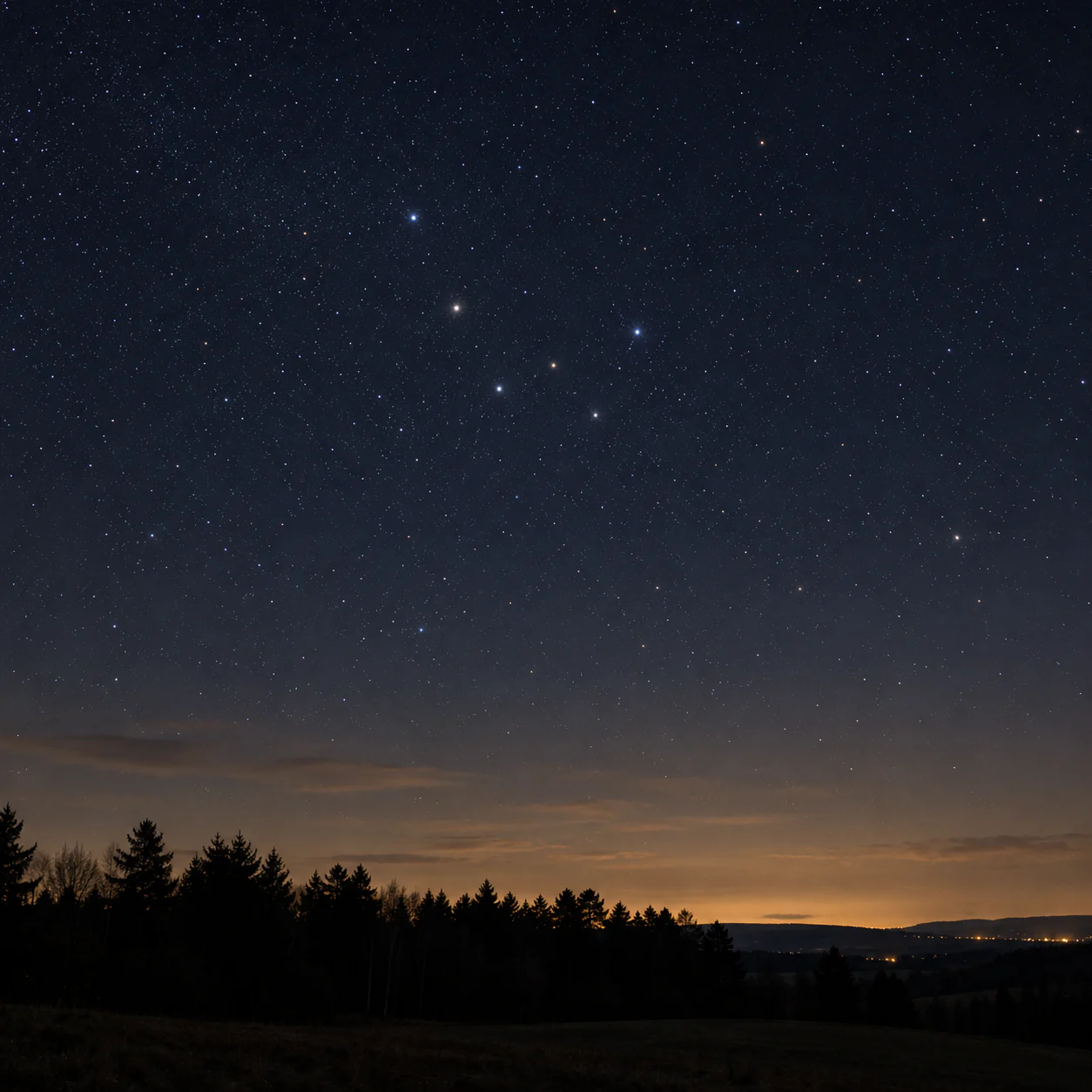
Decide whether Cassiopeia is a suitable target
Cassiopeia is a northern constellation. Its visibility and height depend strongly on latitude, season, local time, and the observer’s horizon. In some northern locations it remains above the horizon throughout the year; farther south it can sit low or be unavailable. Do not use a northern-sky instruction as a promise for every reader.
Open a chart or planetarium set to your location and intended time. Confirm that Cassiopeia is above an open, safe horizon. Note the direction you need to face and the pattern’s predicted tilt. The chart may show a W, an M, or a shape leaning on one side. Those are orientations of the same five-star zigzag, not different constellations.
Choose a place with a broad view and limited direct glare. Give your eyes time to settle, but retain enough light to walk safely. The five principal stars are usually a more practical target than the much fainter Milky Way background shown in long-exposure photographs. Expect points of light, not a bright letter printed on the sky.
Verify the zigzag instead of guessing
Start at one end of the predicted pattern and count five bright points across alternating rises and dips. NASA’s Astronomy Picture of the Day describes the familiar W as five bright stars and shows a broad scene spanning about 15 degrees. That is wider than many beginners first expect. A clenched fist at arm’s length is sometimes used as an informal sky scale, but hands differ, so use the chart’s field and nearby stars rather than treating your hand as a calibrated instrument.
Check the spacing. The points are not equally bright, equally colored, or perfectly symmetrical. If you find a compact, ruler-straight letter, you may be selecting the wrong stars. Follow the full zigzag, then compare its neighborhood with the chart. A second recognizable shape or bright star outside Cassiopeia can strengthen the identification.
Look away for thirty seconds and find the pattern again without tracing from the screen. If you cannot recover it, lower the screen brightness, reset to a wider chart view, and begin from the horizon direction. Success means repeatable identification, not merely seeing something W-shaped once.
Separate the figure from the constellation
The International Astronomical Union recognizes 88 constellations as defined regions of the celestial sphere. The familiar stick figures are useful cultural and teaching aids, but the formal constellation is an area with boundaries, not only the connected bright stars. Cassiopeia therefore includes sky around the W as well as the five points used for the landmark.
This distinction matters when a chart labels an object “in Cassiopeia” even though it does not lie on one of the imaginary connecting lines. It also keeps the exercise honest: the W is an entry point into a region, not a physical group shaped like a letter. The stars appear near one another from Earth’s viewpoint but are not pinned to a flat background.
NASA’s Cassiopeia image also shows different star colors and a rich Milky Way field. A visual observer under suburban light may see much less. Treat photography as evidence of the region’s richness, not as a preview of naked-eye brightness.
Watch the W change its posture
Return two or three hours later if the same site remains safe. The entire pattern will have shifted and rotated in your view as Earth turns. Sketch only its tilt relative to the horizon: upright W, leaning W, side zigzag, or M-like form. Label both times.
Repeat on a later month at a similar clock time. The seasonal relationship between nighttime Earth and the stars changes which constellations are conveniently placed. Your two sketches will not form a precise celestial coordinate measurement, but they will show why a fixed screenshot is a poor substitute for a current chart.
Do not call Cassiopeia a compass needle. The pattern can help you orient within a chart, and experienced northern observers use nearby patterns to work toward Polaris, but the exact route and visibility depend on the sky available to you. If your goal is a direction check, use the dedicated Big Dipper-to-Polaris method when those stars are visible and verify it with a real compass or map rather than relying on a remembered line alone.
Use the landmark without overloading it
Once you can recover the W, use it as the starting frame for one additional task. You might compare the color impression of its brighter stars, scan the surrounding field with binoculars, or simply note which side of the pattern is closest to the horizon. Choose one. Loading a first session with clusters, nebulae, mythology, navigation, and photography makes it harder to know which identification was secure.
Record the chart source, location, local time, cloud cover, and whether direct lights were present. Add a confidence statement: “recovered twice and matched two neighboring stars” is stronger than “probably Cassiopeia.” If you used binoculars, make the naked-eye identification first so the wider context is not lost when the field narrows.
Cassiopeia becomes useful through repetition. The important observations are not that a W exists, but that the pattern spans a broad area, changes orientation, sits inside an official constellation region, and can be found again from the same sky. Those checks turn a memorable nickname into a real seasonal landmark.
Continue observing
- Big Dipper to Polaris: A Northern-Sky Direction Check
- How to Read a Star Map Without Turning the Sky Upside Down