Andromeda is a celebrated galaxy, but a direct visual observation is far more restrained than a long-exposure image. Under a sufficiently dark northern sky, the galaxy may appear as a faint fuzzy patch rather than a spiral with obvious colors. This guide is intentionally cautious: location, season, moonlight, transparency, eyesight and equipment all change the result.
Check whether tonight is plausible
Use a current chart set for your latitude and local time. In northern autumn evenings, Andromeda is often a reasonable target, but its height and timing vary. Choose a night with little bright moonlight and as little direct glare as practical. A galaxy low over city lights is a poor beginner test. Confirm you have legal access to a safe observing site with a clear view. Do not call an object “visible tonight” merely because it is above the mathematical horizon; trees and sky brightness matter.
Find an anchor you trust
NASA suggests the Great Square of Pegasus or Cassiopeia as guides to the Andromeda region. Begin by confirming one of those large naked-eye patterns on a local chart. From there, follow the chart's star-by-star route rather than an image prompt or a generic arrow drawn without scale. If the pattern's orientation does not match the illustration, reset the chart's time and horizon. Star-hopping works only when the starting stars are real and correctly identified. Keep a small note of the last reliable anchor if the final patch remains invisible.
Use the right visual expectation
The central glow is what an observer is most likely to notice; outer arms require different imaging techniques and favorable conditions. Through binoculars, look for a soft elongated blur against nearby star points rather than a detailed multicolored disk. With naked eyes under a dark sky, the patch can be marginal. Look slightly to the side of the suspected position and compare the field after your eyes settle, but do not persuade yourself that a smudge must be there. Record “not confirmed” when appropriate.
Why a search can fail
Thin high cloud, a bright Moon, poor focus and an incorrect chart setting are common problems. A nearby lamp can erase low-contrast glow while leaving bright guide stars visible. If using binoculars, brace your arms and focus on a bright star before attempting the galaxy. Revisit the anchor pattern after every uncertain sweep. If the target still does not separate from the background, make a conditions note and stop. A darker night can matter more than higher magnification, and a too-narrow field may make the route harder.
A truthful article image
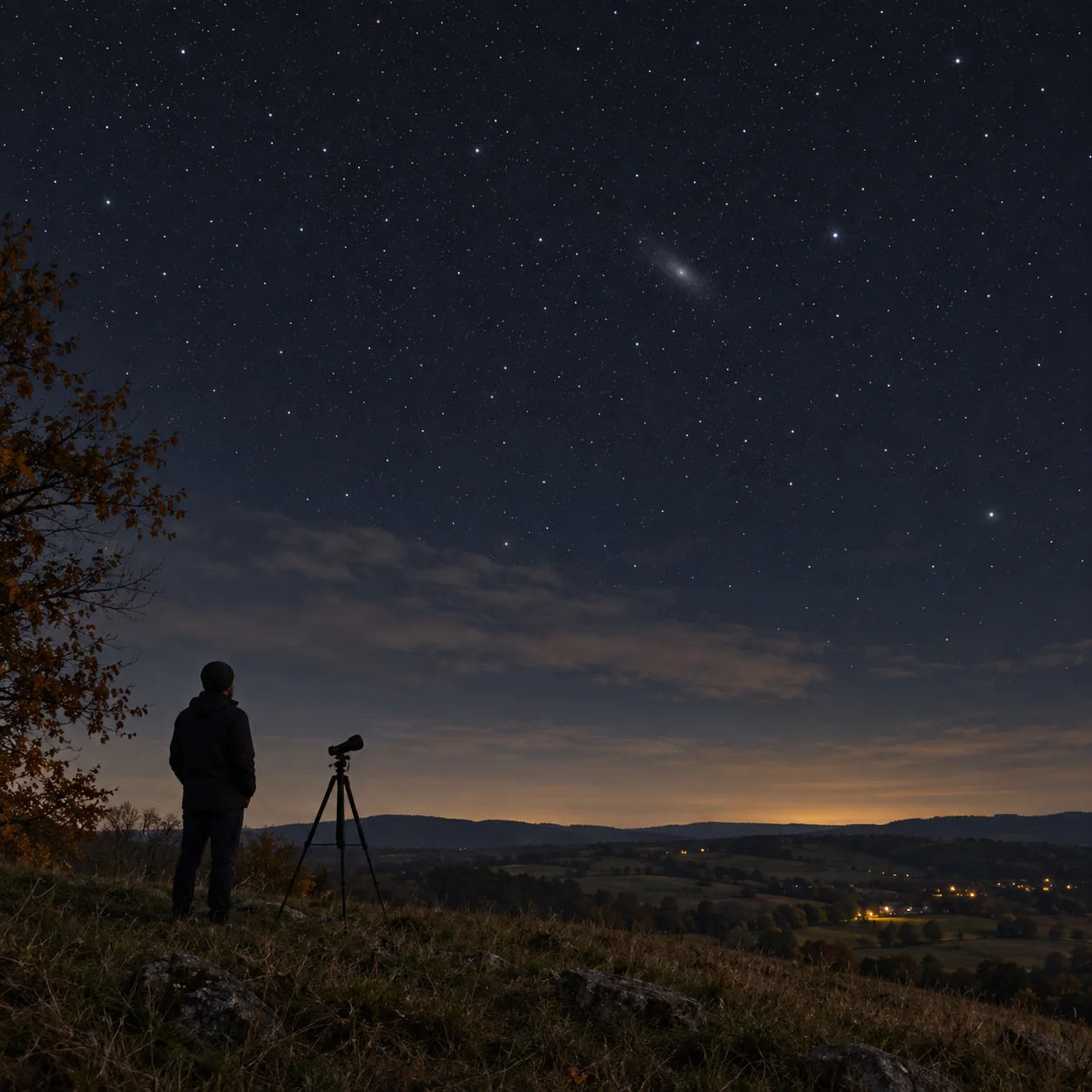
A generated landscape scene or an astrophotograph can illustrate where a person might observe, but it is not proof of how Andromeda looked to that person's eye. Do not overlay a huge pink spiral on a binocular scene. For an actual how-to page, provide a verified local chart or an original accurately plotted diagram with orientation, source and date; this collection's decorative image should not be used as one. The observational account should state equipment and conditions so readers can judge its limits.
How to report a non-detection
On your search night, list the last pattern you identified with certainty, the direction and approximate height of the suspected galaxy field, whether the Moon was present and what optics you used. If no patch separates from the background, write “Andromeda not confirmed” rather than a dramatic failure. The galaxy is a low-contrast target and a city night can still be excellent for the Moon or bright star patterns. A repeat attempt is strongest when you change one practical condition: a darker place, less moonlight, steadier binoculars or a more carefully oriented chart. If several variables change, be modest about the reason for any improvement. Keep a photograph separate from this visual log. Cameras collect light differently from eyes and can detect extended structure that a human observer at that site never perceived. An honest negative observation leaves a clear plan for another night.
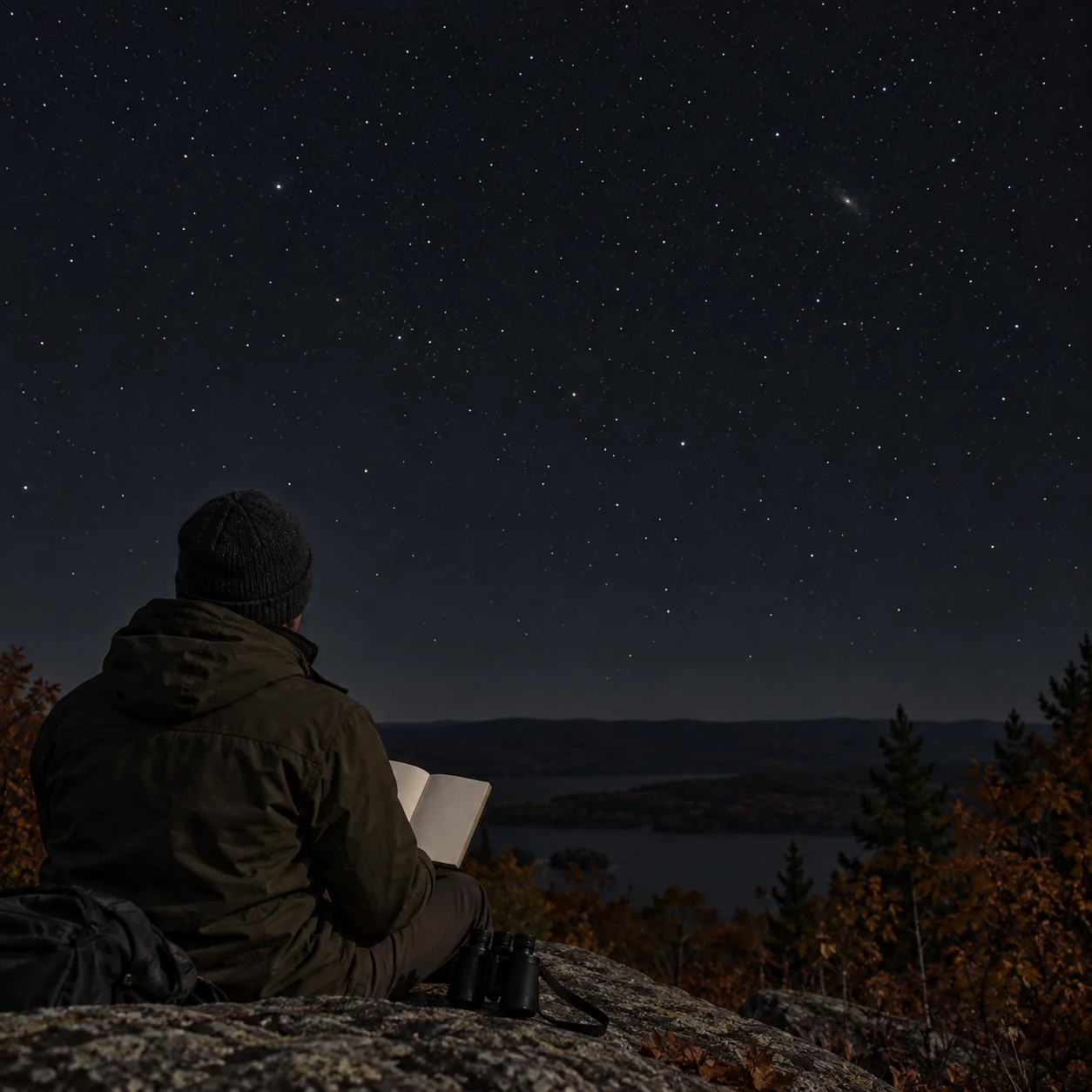
The first successful Andromeda observation may be a barely distinguishable patch. That modest sight is more honest, and often more memorable, than a promised photographic spiral. The galaxy’s vast physical size can mislead beginners into expecting a spectacular naked-eye shape. Angular extent, surface brightness and sky background determine the visual impression. A central fuzzy area is a plausible success even when the outer disk is not distinguishable. That distinction should remain clear in captions as well as in the article body. A chart with a magnitude limit suited to your site is more helpful than an atlas crowded with stars you cannot see from there.
Continue observing
- Use Orion’s Belt to Find the Sword and Its Fuzzy Nebula
- Protect, Clean, and Carry Stargazing Binoculars